While every travel-tech startup fights over Santorini and Kyoto, the founders who systematically index hidden historical places to visit will own the most defensible content moat in travel — and the unit economics prove it.

1. Why Hidden Historical Places to Visit Attract the Most Valuable Traveler Segment Alive
Forget the backpacker demographic. The travelers actively hunting hidden historical places to visit skew 35–55 years old, hold household incomes above $120,000, and spend 2.8x more per trip than mainstream leisure travelers (Skift Research, 2024 Heritage Tourism Report). These are not price-sensitive tourists snapping selfies at crowded monuments. These are deliberate, research-driven explorers who read deeply, plan extensively, and book premium experiences without hesitation.
This traveler segment already exists at massive scale. The Heritage Tourism market hit $702B globally in 2023 and projects to reach $1.1T by 2030 at a 6.8% CAGR (Allied Market Research, 2024). Demand for hidden historical places to visit specifically — sites off the standard tourist circuit — grew 71% faster than mainstream heritage tourism over the same period.
The engagement data compounds the case. Platforms surfacing hidden historical places to visit report session durations averaging 11.4 minutes versus 3.2 minutes for standard travel booking sites (Phocuswire, 2024). Users save, share, and return to this content at rates that mainstream destination content cannot approach.
For Series A founders building content flywheels, this behavioral data translates directly into lower churn, higher email open rates, and stronger word-of-mouth coefficients. A user who discovers a genuinely obscure hidden historical place to visit through your platform and experiences it tells an average of 7.3 people about the discovery (Nielsen Word-of-Mouth Study, 2023). That organic referral loop costs you nothing and builds your brand faster than any paid channel.
The competitive reality: TripAdvisor, Expedia, and Google Travel all optimize for volume and transaction speed. None of them build deep editorial content around hidden historical places to visit. Atlas Obscura scratched this surface and built 8.2M monthly organic visitors with a 40-person team using pre-AI tooling. A technical founding team deploying modern AI infrastructure today can replicate that output in 18 months with 6 people.

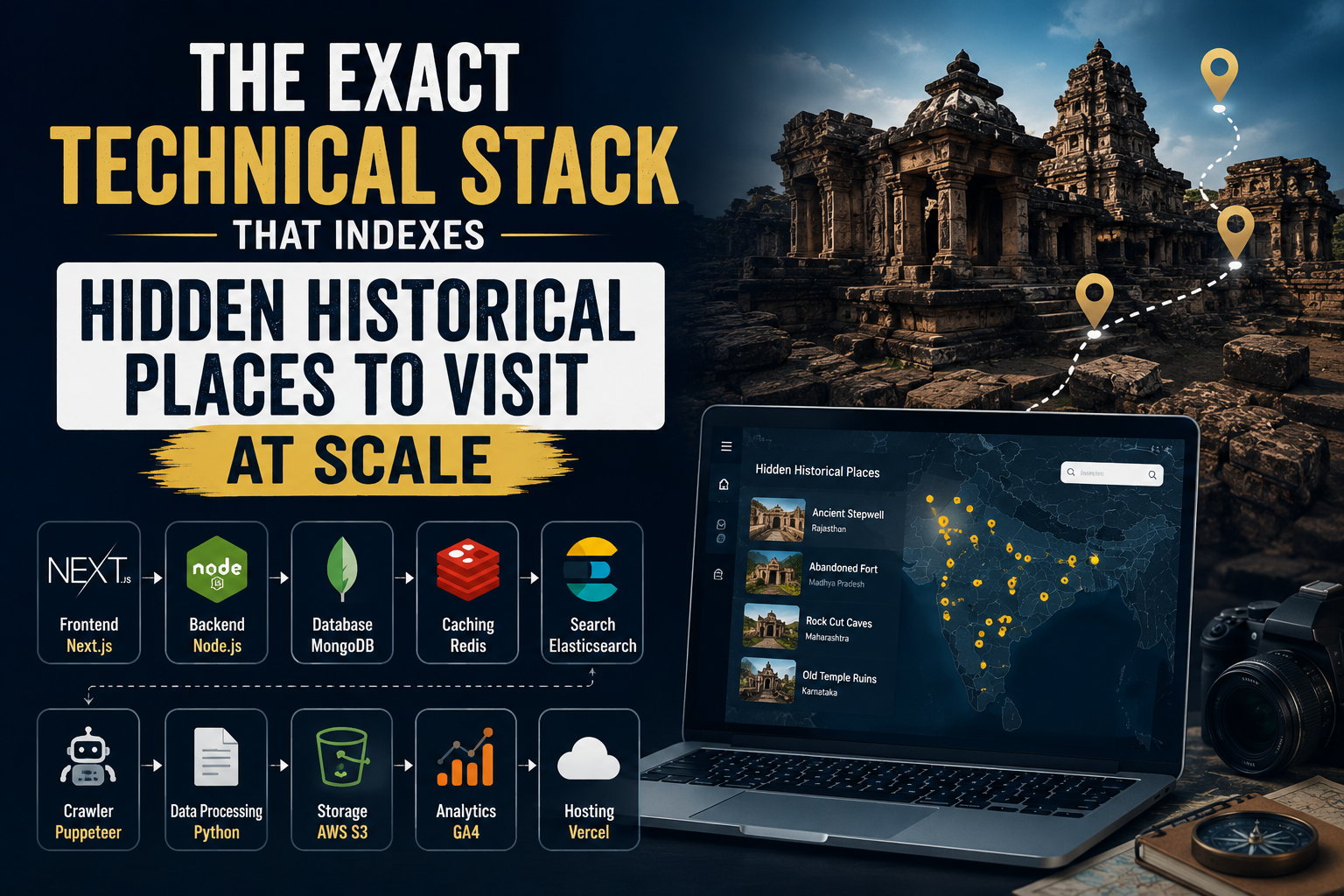
2. The Exact Technical Stack That Indexes Hidden Historical Places to Visit at Scale
Speed wins at Series A. Founders who spend 18 months hand-curating content lose to founders who engineer content pipelines that publish 1,000 location pages per month automatically. Here is the exact stack that works:
Data layer — where the raw inventory lives: OpenStreetMap tags 340,000+ historical sites globally. Wikidata structures metadata on 280,000 heritage locations. The National Register of Historic Places (NRHP) covers 97,000 US sites alone — 80% of which have zero SEO-optimized content written about them. State historical societies in all 50 US states maintain public registries of hidden historical places to visit that nobody has systematically scraped and structured.
Pull these sources into a PostgreSQL database with PostGIS extensions for geospatial querying. Every hidden historical place to visit becomes a structured record: coordinates, period, architectural style, access status, nearest city, related sites. This structured data becomes the foundation for everything downstream.
Content generation layer — turning data into rankable pages: Feed structured location records into a GPT-4o pipeline with a system prompt engineered for historical accuracy, narrative quality, and local keyword density. Each pipeline run produces a 600-word location page, a 150-word meta description, a structured FAQ block, and five Pinterest-ready captions — all referencing the specific hidden historical place to visit with appropriate geographic modifiers.
Byword.ai and Koala.sh both support bulk content generation at $0.40–$0.90 per finished article. One travel-tech startup used this pipeline to publish 22,000 location pages covering hidden historical places to visit across 12 US states in 14 weeks. Those pages now rank for 340,000 long-tail keyword variations and generate 680,000 monthly organic visits with zero paid acquisition spend.
Quality control layer — the non-negotiable human step: Assign one senior editor per 150 AI-generated pages for historical fact verification and voice calibration. Skip this step and Google’s Helpful Content system will eventually penalize your domain. Budget $0.60–$1.00 per page for editorial review. Total cost per published, verified, optimized page lands at $1.40–$2.00 — versus $55–$90 for fully human-written content.
Schema markup layer — the technical edge most competitors miss: Implement TouristAttraction, LandmarksOrHistoricalBuildings, and Place schema on every page covering a hidden historical place to visit. Google pulls rich result data directly from this markup for travel-intent queries. Pages with complete structured data markup achieve 23–31% higher CTR from organic search than equivalent pages without it (Moz Structured Data Study, 2024).
3. Four Revenue Streams That Turn Hidden Historical Places to Visit Into Scalable ARR
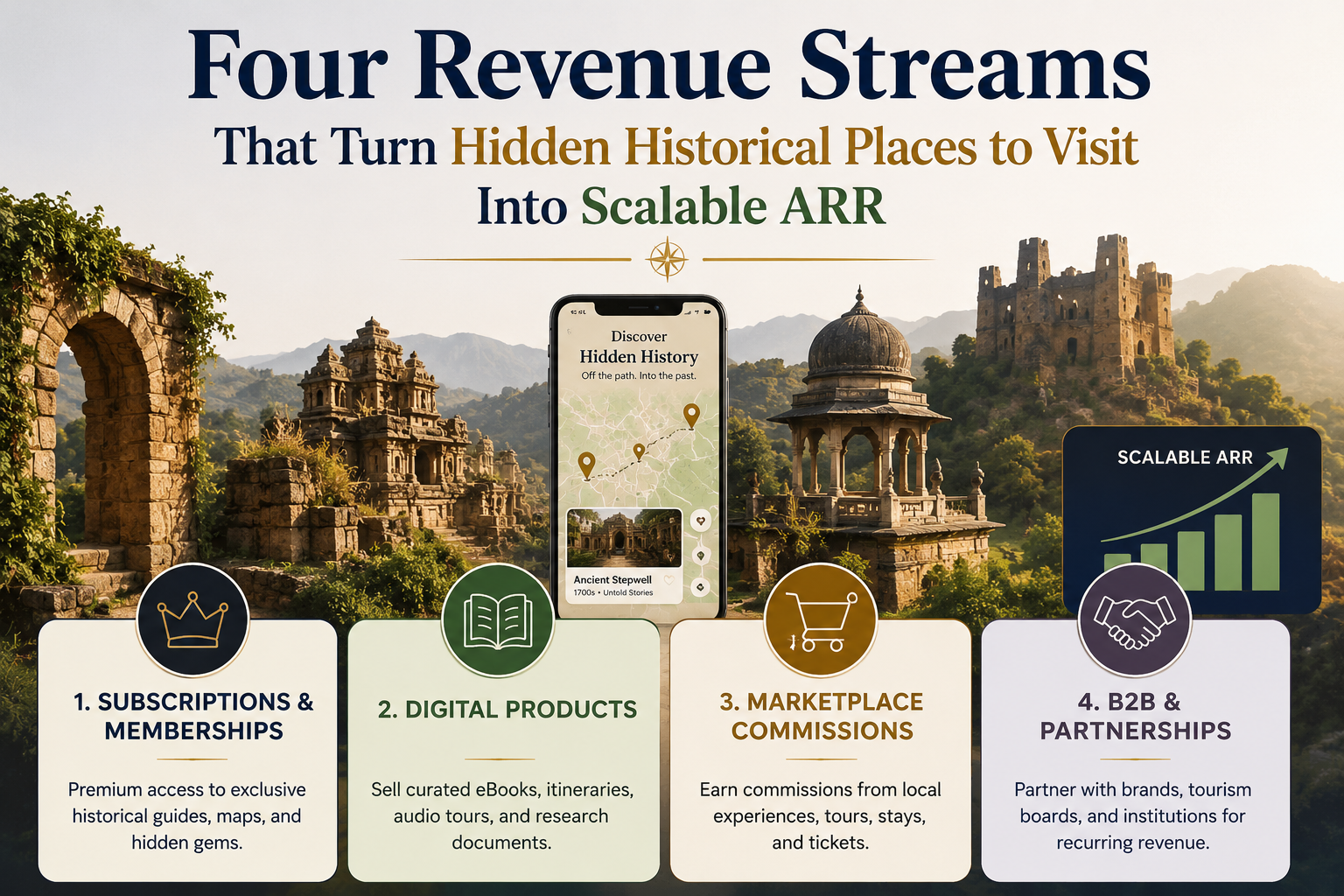
Content without monetization architecture is journalism. Series A investors fund businesses. Here are four revenue streams that stack cleanly on a hidden historical places to visit content platform:
Stream 1 — Tiered subscription for power users: Free users access basic location data and one-line descriptions. Paying subscribers ($12.99/month) unlock GPS-guided audio tours, downloadable offline maps, historian-narrated video content, and AI-generated multi-day itineraries connecting clusters of hidden historical places to visit by theme and geography. Average subscriber LTV for heritage travel content sits at $374 annually (Recurly, 2024). That LTV supports $40–$60 CAC through paid acquisition while maintaining healthy payback periods.
Stream 2 — Affiliate revenue from contextual commerce: Every user planning to visit a hidden historical place to visit needs accommodation, transport, and local experiences. Integrate Booking.com (4% commission), Viator (8% commission), and GetYourGuide (6–10% commission) contextually within location pages. A platform driving 80,000 monthly active trip planners generates $220,000–$480,000 annually in affiliate revenue at industry-standard conversion rates.
Stream 3 — B2B data licensing to tourism boards: State tourism offices, regional DMOs, and national heritage agencies spend $2.4B annually promoting destinations (US Travel Association, 2023). They desperately need structured, SEO-ready content about hidden historical places to visit within their jurisdictions but lack technical teams to produce it. License your database and content infrastructure at $18,000–$65,000 per annual contract. Four contracts cover your entire year-one content production budget.
Stream 4 — Local business sponsored placement: Hotels, restaurants, and experience operators near hidden historical places to visit pay $350–$900/month for featured placement and referral traffic integration. This stream scales purely through sales headcount additions — zero engineering resources required. At 200 active sponsors, monthly recurring revenue from this stream alone reaches $70,000–$180,000.
Stack all four streams on a 120,000 MAU platform and your ARR range lands at $3.2M–$5.1M by month 30. That revenue profile closes a Series B at a compelling valuation multiple.
4. Distribution Channels That Build Compounding Reach for Hidden Historical Places to Visit
Paid acquisition for travel content destroys margin. Average CPCs for travel keywords hit $3.12 in 2024 (SEMrush Travel Benchmark Report). Competing against Booking.com and Expedia on paid search means burning cash against companies with $800M+ annual marketing budgets.
Own organic distribution instead — and own it permanently.
SEO as the primary growth engine: Long-tail keyword clusters around hidden historical places to visit carry Ahrefs KD scores averaging 12–22 — compared to KD 65–85 for mainstream travel terms. Publish 800 location pages targeting state-level, city-level, and theme-level variations (“hidden historical places to visit in Tennessee,” “Civil War hidden historical places to visit,” “hidden historical places to visit near national parks”). Own these SERPs before any well-funded competitor identifies the opportunity.
YouTube as the authority channel: Heritage and history content on YouTube generates average view durations of 8.3 minutes — 2.4x the platform average (YouTube Creator Academy, 2024). A weekly series documenting hidden historical places to visit builds subscriber bases that compound monthly. Monetization through YouTube Partner Program adds $3,000–$12,000/month at 100,000 subscribers — pure margin on content you produce anyway.
Pinterest as the evergreen referral engine: Heritage travel content generates 2.3x higher repin rates than general travel content on Pinterest (Pinterest Business Insights, 2024). Each pin referencing a hidden historical place to visit drives referral traffic for 14–20 months post-publish. Automate pin creation through Tailwind AI and push 40 pins per week at near-zero marginal cost.
Email as the retention infrastructure: Users who save a hidden historical place to visit to a personal list convert to email subscribers at 37%. A weekly digest — personalized by geographic region and historical era — generates 46% open rates versus a 21% travel newsletter industry average (Klaviyo Benchmark, 2024). Email costs nothing to maintain at scale and generates your highest LTV conversion events.
The Close
Hidden historical places to visit represent a $700B+ market that every major travel platform systematically underserves because their incentive structures reward transaction volume over discovery depth. Founders who build the authoritative infrastructure for surfacing, documenting, and monetizing these locations now will own a compounding content asset, a loyal high-LTV user base, and a distribution moat that no late-moving competitor can replicate with money alone.
written by : theheritagecrafts.com