You booked flights across Central Asia once — you sat in five different airports, lost 22 hours to layovers in Tashkent and Almaty, and still missed Samarkand because a connection canceled. The Silk Road tour by train 2026 fixes every one of those failures, and the numbers back it.

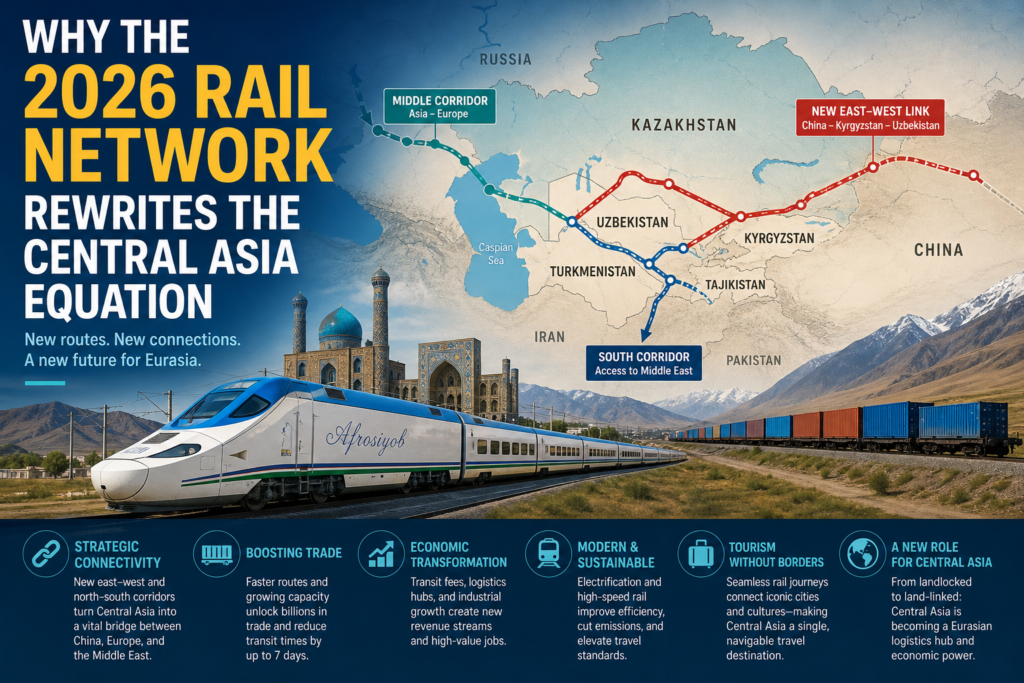
Why the 2026 Rail Network Rewrites the Central Asia Equation
The rail infrastructure connecting Uzbekistan, Kazakhstan, and Tajikistan has undergone its most significant upgrade cycle since the Soviet era. Uzbekistan Railways completed the Angren–Pap electrified line in 2016, but 2025–2026 brought the expansion most travelers had been waiting for: higher-frequency Afrosiyob high-speed trains now run Tashkent–Samarkand in 2 hours 10 minutes, with extended service pushing toward Bukhara in under 4 hours.
Kazakhstan’s Talgo-operated intercity routes cut the Almaty–Turkestan corridor to 9.5 hours — a route that took two full driving days just five years ago. Turkestan, with its UNESCO-listed Mausoleum of Khoja Ahmed Yasawi, now sits within clean day-trip range of Almaty for anyone building a serious itinerary.
The practical implication for a Silk Road tour by train in 2026: you route through four major ancient cities — Almaty, Tashkent, Samarkand, Bukhara — on a single unbroken rail spine. No chartering. No domestic flight roulette. No lost bags between Uzbek Air hops. You board, you arrive, you operate.
The Real Cost Comparison of a Silk Road Tour by Train
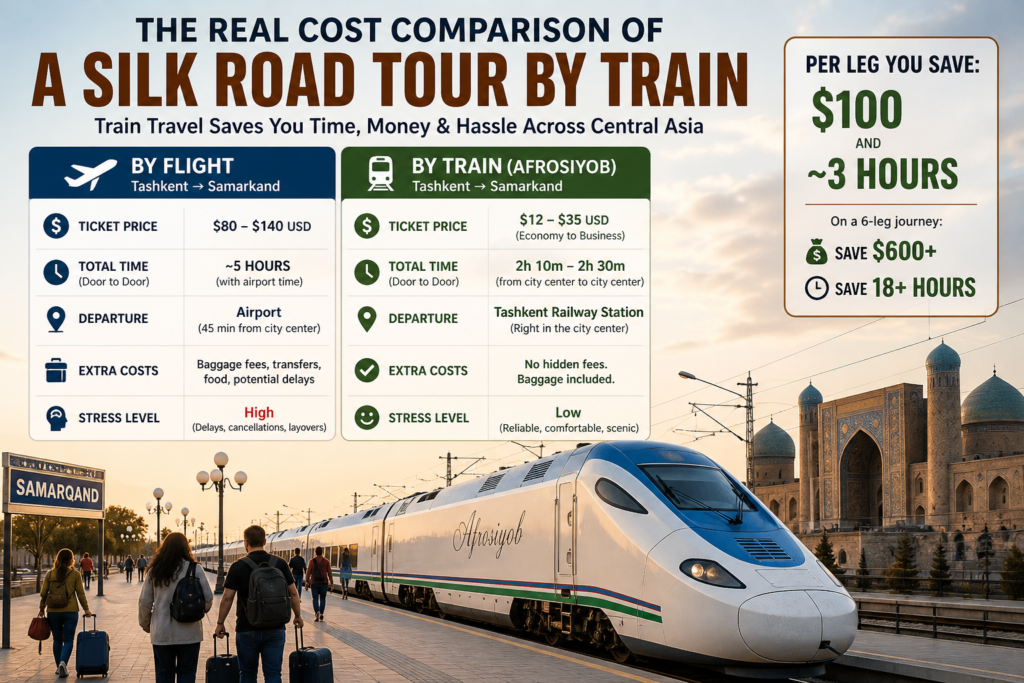
Founders benchmark everything, so benchmark this. A direct Tashkent–Samarkand flight, when available, runs $80–140 USD. Add airport transit time (45 min each end, minimum), check-in friction, and the dead hours in between, and you’ve spent $140 and 5 hours moving 350 km. The Afrosiyob train ticket costs $12–18 in economy, $25–35 in business class, departs from city-center Tashkent railway station, and deposits you inside Samarkand’s city grid 130 minutes later.
That delta — roughly $100 and 3 hours per leg — compounds fast across a 14-day silk road tour by train itinerary in 2026.” On a six-leg journey, you save $600 and 18 hours. You spend those 18 hours watching the Kyzylkum Desert slide past your window, working offline, or sleeping flat in a coupé berth on an overnight to Bukhara. The alternative is a departure hall chair and a gate delay.
The overnight sleeper economics deserve their own line. The Tashkent–Bukhara night train costs $20–35 for a berth. You travel, you sleep, you arrive at 6 AM having paid for neither a hotel night nor a flight. Across a multi-week Silk Road itinerary, three overnight trains eliminate three hotel nights. At Central Asian mid-range hotel rates ($60–90/night), that’s $180–270 back in your pocket before you’ve bought a single meal.
The Itinerary Architecture That Actually Works
Every traveler who attempts the Silk Road tour by train for the first time builds the wrong itinerary: they try to radiate outward from Tashkent by flight and double back constantly. The 2026 Silk Road tour by train forces better architecture — a linear spine with intentional branching.
The Proven 14-Day Rail Spine:
Start in Almaty. Take the Talgo overnight southwest to Turkestan (9.5 hrs), spend a full day at Yasawi’s mausoleum and the Hirat Archaeological Complex. Board the cross-border train into Tashkent (6 hrs), which now runs with consistent border processing times under 90 minutes with pre-registered e-visas. Give Tashkent two full days — the Chorsu Bazaar, the Amir Timur Museum, the Soviet modernist architecture district nobody photographs but everyone remembers.
Then the Afrosiyob to Samarkand. Three days minimum: Registan Square at dawn before the tour groups arrive, Shah-i-Zinda necropolis in afternoon light, Ulugh Beg’s Observatory. Rail to Bukhara (1.5 hrs on the new express). Two days: the Ark Citadel, Kalon Minaret, the working caravanserais now operating as boutique hotels. Optional branch: shared taxi to Khiva (5 hrs), the walled city that functions as a living medieval set. Return to Tashkent by train, fly home.
This itinerary requires zero domestic flights, zero chartered vehicles for intercity movement, and zero re-routing after cancellations. A Silk Road tour by train 2026 built on this spine runs on a timetable you can actually trust.
What 2026 Changed for Visas, Connectivity, and Booking
Three friction points killed Central Asia itineraries for independent travelers before 2022: visas, offline dead zones, and untranslated booking systems. All three have measurably improved.
Visas: Uzbekistan’s e-visa system processes in 2–3 business days for 96 nationalities and costs $20. Kazakhstan added India, China, and most of Southeast Asia to its visa-free or visa-on-arrival list in 2023–2024, a policy that held through 2026. Tajikistan’s e-visa covers the Pamir Highway access most adventure travelers want. The Silk Road tour by train 2026 now runs nearly paperwork-free for travelers from most OECD countries plus a growing number of Asian passport holders.
Connectivity: Uzbekistan Telecom’s 4G coverage reached 89% of populated corridors by late 2025. eSIM providers including Airalo and Holafly now offer Uzbekistan-specific data plans at $8–15 for 10GB — activated before departure, zero SIM-swap friction at the border. Kazakhstan’s coverage on the Almaty–Turkestan rail corridor is effectively continuous.
Booking: UzRailPass introduced an English-language booking interface in mid-2025 that accepts international Visa and Mastercard without the routing-through-local-bank workaround that frustrated travelers for years. Tickets for Afrosiyob trains sell out 7–10 days in advance during peak season (April–May, September–October). Book early or pay the reseller markup.
One real constraint remains: the Tashkent–Ashgabat Turkmenistan crossing requires a transit visa that takes 10–15 business days and involves a letter of invitation. If your 2026 Silk Road tour by train itinerary includes Turkmenistan, build that buffer into your timeline or reroute around it.

The Silk Road Has Always Been a Route, Not a Destination
The ancient merchants who moved silk, spices, and glassware between Chang’an and Constantinople did not fly point-to-point. They moved continuously — trading, observing, and accumulating knowledge along the path itself. A Silk Road tour by train in 2026 restores that logic to modern travel.
The journey between cities carries as much weight as the cities themselves. Book the train.
Written by : theheritagecrafts.com